
Company olympics and Survivor-style challenges: organising great team games
Brightly coloured tribes, timed challenges, a totem to win: company olympics and Koh-Lanta-style adventures (the French Survivor) remain the go-to formats for large outdoor team building days. Well organised, they bring hundreds of people together; badly prepared, they exhaust people and leave some out.
Entertainment and team building 5 min read Updated on

Company olympics, Survivor or Fort Boyard: what is the difference?
These three formats share the same principle (teams working through a series of challenges and building up points) but they do not have the same atmosphere.
| Format | Atmosphere | Typical challenges | Duration and group size |
|---|---|---|---|
| Company olympics | Sporty and good-natured | Relays, throwing games, tug of war, skill games | Around 2 hours 30, up to 420 |
| Survivor-style adventure (Koh-Lanta) | Strategic, tribal spirit | Obstacle courses, balance, puzzles, winning the totem | Around 2 hours 30, up to 420 |
| Fort Boyard-style fort quest | TV game show, suspense | Challenges to win keys, clues, a caged finale | Around 2 hours 30, up to 420 |
| Giant party game | Festive, laughter | 36 mini-games inspired by video games | Around 2 hours 30, up to 224 |
Company olympics suit a broad audience and a light-hearted atmosphere. The Survivor-style adventure adds a strategic dimension (alliances, choosing who takes on each challenge) that appeals to competitive teams. The fort quest also works indoors or at an estate with buildings, which makes it less dependent on the weather.
How do you design challenges for everyone?
This is the main pitfall: challenges that are too physical turn team building into a sports session, where the sportiest shine and everyone else waits around. A good programme alternates:
- Skill challenges: ring toss, palets (a French throwing game), suction-cup archery, a blindfolded course guided by a teammate.
- Brainpower challenges: riddles, a giant puzzle, a code to crack.
- Cooperation challenges: team skis, building a tower, a human chain passing water.
- A little movement: a short relay, a sack race, but never an elimination challenge based on endurance.
Every team must be able to score points thanks to different profiles. Also plan non-physical roles (strategist, captain, totem bearer, photo reporter) for people who are injured, pregnant or simply not comfortable.
What team size and what pace?
Teams of 8 to 12 people strike a good balance: enough to share out the roles, not so many that people get left out. Challenges rotate every 10 to 15 minutes, across stations spread over the site, each run by a facilitator who explains the rules and records the scores. A shared finale, in front of everyone, lets you finish on a high and name the winning tribe.
How does a typical half-day run?
- Welcome and forming the tribes: each participant receives a scarf or bandana in their team colour, and the teams choose a name and a rallying cry.
- General briefing: a host on the microphone presents the rules, the points system and safety.
- Rotating between stations: teams move through the challenges following a posted schedule, with a water break halfway.
- Finale: the top two or three teams face off in front of the whole group, for example to win the totem.
- Prize-giving and drinks: podium, group photo, then drinks or a meal to make the moment last.
Allow around 2 hours 30 for the game itself, plus time for the welcome and the close. During a seminar day, the afternoon works well, after a morning of work indoors.
How do you link company olympics to your corporate message?
The games can carry your messages without being heavy-handed: challenges named after your values, a riddle whose answer is one of the year’s key figures, a totem in the company colours. Teams can also represent projects or regions. The important thing is that the game stays a game: if every challenge becomes a communication exercise, the energy drops. Think about photos too: a photographer following the challenges captures images full of life, ideal for internal communication, and every team loves seeing itself in action the next day.
Where can you hold company olympics in Provence?
You need flat, open ground, ideally with some shade, easy access for equipment and toilets. The estates and country houses around Aix and Aubagne, parks, the Prado beaches available for private hire and the large gardens of some seminar venues all work well. A beach makes an ideal setting for a Survivor-style challenge, but sand is quickly tiring: go easy on the running challenges.
What precautions should you take in summer in Provence?
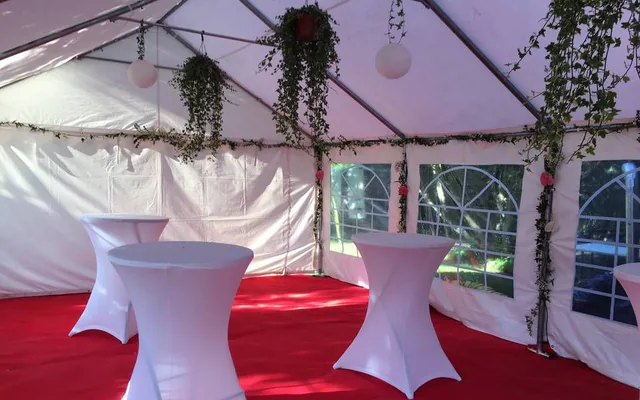
Heat is the number one risk of an outdoor team game in Marseille. In July and August, schedule the challenges before 11am or after 5pm, set up shaded areas (a 3 × 3 m gazebo hires for €150 with us), hand out water continuously and provide caps and sun cream. The mistral can also blow away light equipment: weight down anything that could fly off. For details, see our article on weather and outdoor events.
How much do company olympics cost?
The price depends on the group size, the number of facilitators, the duration and the venue. Supervised formats are priced per person, with a minimum charge. To compare quotes, check the number of challenges, the ratio of facilitators to teams, whether team outfits or scarves are supplied, and the sound system for announcements and the prize-giving. Our olympics and adventures are on quotation; we can add a sound system, a photographer to capture the challenges, and the evening that follows.
Questions we are often asked
How do you organise company olympics?
Choose an open site (a park, a beach, an estate), form mixed teams of 8 to 12 people, plan 6 to 10 varied challenges (skill, brainpower, cooperation, a little running) that rotate every 10 to 15 minutes, and have facilitators act as referees. A full format lasts around 2 hours 30 and can bring together up to 420 participants.
A Survivor-style challenge (Koh-Lanta) for companies: how does it work?
Participants are split into tribes who compete in challenges inspired by the TV show (Koh-Lanta is the French version of Survivor): obstacle courses, skill games, puzzles, a balance challenge, then a final to win the totem. The adventure lasts around 2 hours 30 outdoors, with challenges adapted so everyone can take part, without any physical feats.
Go further
- Team building
- Corporate seminar
- Incentive
- Company olympics, Koh-Lanta and Fort Boyard
- Interactive walls and giant games
- Corporate escape game
- Aix-en-Provence
- Sport Beach, Prado beaches
- Arles and the Camargue
- Marseille
- Guide: Corporate escape game: which format should you choose for your team?
- Guide: How much does a casino night or a team-building activity cost?
- All frequently asked questions
More advice
Let’s organise your company olympics
Tell us your group size, the date and the venue you have in mind: we will suggest a suitable programme of challenges, costed within 48 hours.