
Why choose a single point of contact for your event?
Five suppliers, five quotes, five deposits, five phone numbers: that is daily life for anyone organising a corporate party without coordination. A single point of contact promises to simplify all of this. Here is what that promise really covers, and how to check it will be kept.
Choosing your suppliers 5 min read Updated on

What is a single point of contact for an event?
It is one person, and one company, who takes charge of all the services for your event and is accountable to you for them. You explain what you need once; they build the proposal, book the teams, set the schedule, then coordinate everyone on the day. For you, this translates very practically into:
| Without a single point of contact | With a single point of contact |
|---|---|
| One quote per supplier, to compare and chase | One overall quote, itemised line by line |
| Several contracts, several deposits | One contract, one deposit, one invoice |
| You send the timings to each supplier | One running order, shared with every team |
| When something goes wrong, everyone blames someone else | One person responsible for the solution |
| You spend the evening on the phone | You enjoy the event |
What are the practical benefits?
Real time savings
For a party of 150 people, the time spent coordinating five suppliers runs into days: calls, emails, reminders, schedule changes. With a single point of contact, that work disappears from your diary.
Overall consistency
The DJ knows what time the caterer is serving, the technician knows when the speech begins, the photographer knows who to photograph. When the teams already know each other and are used to working together, transitions happen without you having to step in.
Clear responsibility
If the sound system fails during the speech, you do not need to work out whether it is the fault of the DJ, the venue or the technician. You call one person, and they fix the problem.
A budget under control
An overall quote shows you at a glance where the money goes, so you can make trade-offs: less decoration and a better bar, for example. Grouping services with one supplier often unlocks discounts: with us, 5% from 2 services, 10% from 4 and 20% from 10.
What limits should you be aware of?
A single point of contact is not a magic solution. Three points deserve your attention:
- Dependence: if your contact falls ill or disappears, the whole project is weakened. Ask who takes over.
- Hidden subcontracting: some “single points of contact” simply resell outside suppliers, with a margin and fees on top. That is not a problem in itself, but you need to know.
- Scope: check what is actually included. Are the venue and the caterer within the scope, or do they remain your responsibility?
Intermediary or in-house team: what is the difference?
There are two kinds of single point of contact. The agency that coordinates outside suppliers brings genuine organisational know-how, paid for through management fees of 6 to 10% of the budget and a margin on each service: in quotes from Marseille agencies, a DJ came to around €1,100 and a photo booth to around €750. A network that delivers the music, technical set-up, bar and photography itself offers the same ease of management, with direct prices: a DJ from €299, a photo booth from €349.
The right choice depends on your project. For an incentive trip abroad with flights and hotels, a specialist agency is often the right answer. For a party, a seminar or a gala in Provence, where success depends mostly on atmosphere, technical set-up and coordination, an in-house team is often simpler and more economical.
How does a project with a single point of contact work?
With us, the project follows four stages, which you will find under different names with most serious organisers:
- Proposal: a conversation to understand your goal, your audience and your budget, then a detailed proposal within 48 hours.
- Approval: adjustments, signature, a 30% deposit, then the action plan and planning timeline are launched.
- Delivery: site visit, a timed running order shared with every team, on-site coordination on the day.
- Review: a debrief of the event, photos delivered, points to improve for the next edition.
What does an evening run by a single point of contact look like?
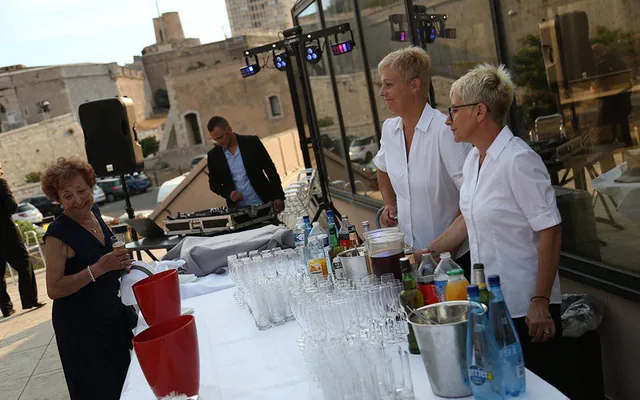
Take a corporate party for 150 people in a private-hire restaurant on the Corniche. In the early afternoon, the technician sets up the sound system and microphones, while the bartender prepares the bar and the photographer scouts the venue. At 6pm, your contact goes round the teams with the printed running order. At 7.30pm, guests arrive to discreet background music; at 8.30pm, the music goes down for the director’s speech, with the microphone tested beforehand; at 9pm, the photo booth opens and the DJ picks up the pace.
If the caterer is running a quarter of an hour late, it is your contact who warns the DJ and pushes back the speech. You, meanwhile, are with your teams. That is the whole difference: the problem still exists, but you are no longer the one handling it.
What questions should you ask to check the promise?
- Will you personally be there on the day of the event?
- Who replaces you if you are unavailable?
- Which services do you deliver with your own teams?
- Does the quote itemise each service, or only give a total?
- How are you paid for the services you do not deliver yourself?
To compare several organisers, see our guide to choosing an event agency in Marseille.
Questions we are often asked
A single point of contact for an event: what difference does it really make?
A single point of contact centralises your conversations, your quotes and the coordination of every supplier: you have just one contract, one invoice and one number to call on the day. They take responsibility for the whole event, which stops the DJ, the caterer and the technician passing the buck when a problem arises.
Single point of contact: how is it different from an agency that subcontracts?
A traditional agency is also a single point of contact, but it often subcontracts the services and charges management fees, usually 6 to 10% of the budget. A network that delivers the music, technical set-up, bar and photography itself offers the same ease of management, with teams who know each other and without that extra layer of intermediary.
More advice

One contact for everything
Tell us about your event: we will introduce your contact and send a detailed proposal, itemised line by line, within 48 hours.